The bundle promise and delivery boundary
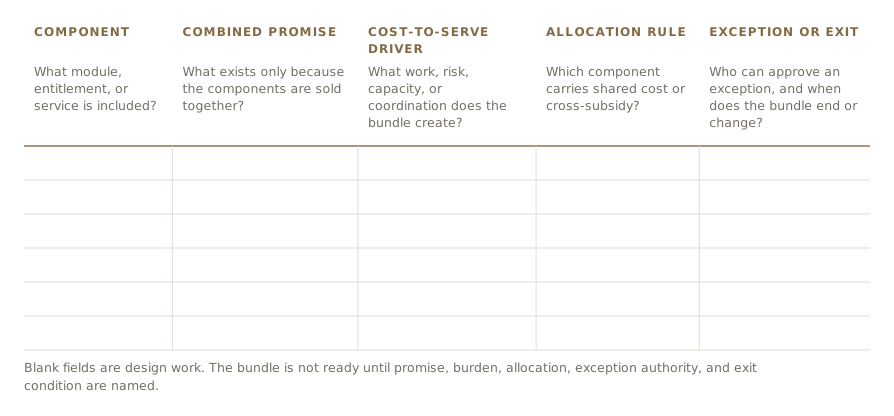
Keep the combined promise and the shared delivery burden in the same decision object. A bundle is incomplete when allocation, exception authority, or exit is blank.
Reference & Evidence
Source: Author's bundle decision worksheet grounded in Simon (2015), Zbaracki et al. (2004), Kienzler et al. (2021), and Urbany et al. (1989). All fields are synthetic; no current bundle data is shown.
Each line is a claim from the register this journal publishes against, resolved from the register at build time.
- B Price is not one number: the book sets out "the many dimensions of prices": bundles, negotiated prices, wholesale, retail and manufacturers' suggested retail prices Simon (2015), pp. 11-13 · published full text ·
G04-C1 - B In B2B the list price is a starting point: suppliers use it "at best as guidance or starting point they negotiate intensely over terms and conditions such as discounts payment terms order minimums and on invoice and off invoice rebates" Simon (2015), pp. 12-13 · published full text ·
G04-C2 - A The cost types, named: "we identify and measure three types of managerial costs information gathering decision making and communication costs and two types of customer costs communication and negotiation costs" zbaracki-etal-2004-price-adjustment-costs · published full text ·
G04-C5 - A One firm, and the paper says so: the totals are "1 22 of the company s revenue and 20 03 of the company s net margin": a single U.S. industrial manufacturer, not a benchmark zbaracki-etal-2004-price-adjustment-costs · published full text ·
G04-C6 - A At equal cost, 68% of purchasing professionals chose the flat rate (Study 1, n = 124, ~40 per condition, cloud analytics). The design is scenario-based: "A series of four experiments showed that experienced purchasing professionals tend to exhibit a flat-rate bias in their price plan choices", and "they preferred the flat-rate over the pay-per-use option" in the equal condition Kienzler, Kowalkowski & Kindström (2021), Journal of Business Research 132, 403–415 · VoR held ·
KKK21-C1 - A Only the bounds varied: "All participants saw the same past average monthly usage (500 h), but the minimum and maximum usage values were varied to create two conditions (100 and 600 h versus 400 and 900 h, respectively)", and "Participants in the equal condition (89%) were significantly more likely than chance to choose the flat rate when past usage indicated upper bound extremes", while "However, this was not the case (56%) when past usage information indicated lower bound extremes" Kienzler, Kowalkowski & Kindström (2021), Journal of Business Research 132, 403–415 · VoR held ·
KKK21-C3 - A The KKT prediction held: "we obtain empirical support for kkt s prediction that unjustified price increases are perceived as unfair while cost justification legitimates a price increase in consumers eyes" urbany-madden-dickson-1989-dual-entitlement ·
URB89-C1
Grades: A, verified against the printed page of the primary source · B, primary source, text layer only · C, authoritative secondary · D, reported.
Related exhibits
-
The tier-promise and cost boundary
From the essay Tiered pricing is a promise with a cost-to-serve boundary
-
The seven-layer pricing architecture map
From the essay Pricing architecture is a system, not a price list
-
The dynamic-price control map
From the essay Dynamic pricing needs a trigger, constraint, and explanation