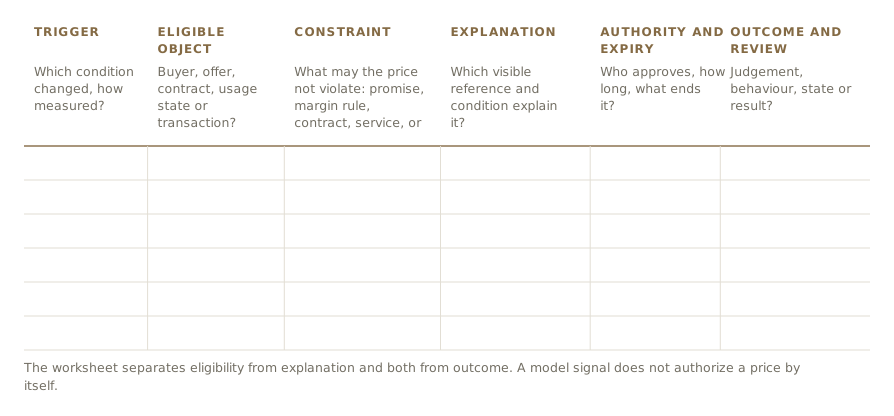
The dynamic-price control map
A changing price needs a trigger, a protected boundary, a visible reference, an owner, an expiry, and an outcome. A blank field is an unresolved control question.
Reference & Evidence
Source: Author's decision worksheet grounded in Zhang, Netzer and Ansari (2014), Urbany, Madden and Dickson (1989), Kahneman, Knetsch and Thaler (1986), and Zbaracki et al. (2004). Labels are synthetic; no customer identifiers, prices, algorithms, or current operating data are shown.
Each line is a claim from the register this journal publishes against, resolved from the register at build time.
- A Two latent states, named in the paper: "a “vigilant” state that is characterized by heightened price sensitivity and a cautious approach to ordering and a “relaxed” state with purchase behaviors that are consistent with high relational trust", and "the seller's pricing decisions can transition buyers between these two states". One industrial-consumables retailer, longitudinal transactions zhang-netzer-ansari-2014-dynamic-targeted-pricing ·
ZNA14-C1 - A The KKT prediction held: "we obtain empirical support for kkt s prediction that unjustified price increases are perceived as unfair while cost justification legitimates a price increase in consumers eyes" urbany-madden-dickson-1989-dual-entitlement ·
URB89-C1 - A And the part usually dropped: "we also find however that fairness perceptions are not significantly related to behavioral intentions as the theory would suggest" urbany-madden-dickson-1989-dual-entitlement ·
URB89-C2 - A "it is acceptable for a firm to raise prices or cut wages when profits are threatened and to maintain prices when costs diminish it is unfair to exploit shifts in demand by raising prices or cutting wages" kahneman-knetsch-thaler-1986-fairness ·
KKT86-C1 - A Dual entitlement, defined: "transactors have an entitlement to the terms of the reference transaction and firms are entitled to their reference profit" kahneman-knetsch-thaler-1986-fairness ·
KKT86-C2 - A The cost types, named: "we identify and measure three types of managerial costs information gathering decision making and communication costs and two types of customer costs communication and negotiation costs" zbaracki-etal-2004-price-adjustment-costs · published full text ·
G04-C5 - A One firm, and the paper says so: the totals are "1 22 of the company s revenue and 20 03 of the company s net margin": a single U.S. industrial manufacturer, not a benchmark zbaracki-etal-2004-price-adjustment-costs · published full text ·
G04-C6
Grades: A, verified against the printed page of the primary source · B, primary source, text layer only · C, authoritative secondary · D, reported.
Related exhibits
-
The synthetic price-fairness record
From the essay What is price fairness? A reference and process problem
-
The tier-promise and cost boundary
From the essay Tiered pricing is a promise with a cost-to-serve boundary
-
The bundle promise and delivery boundary
From the essay Pricing architecture is a system, not a price list