Versprechen und Leistungsgrenze des Bundles
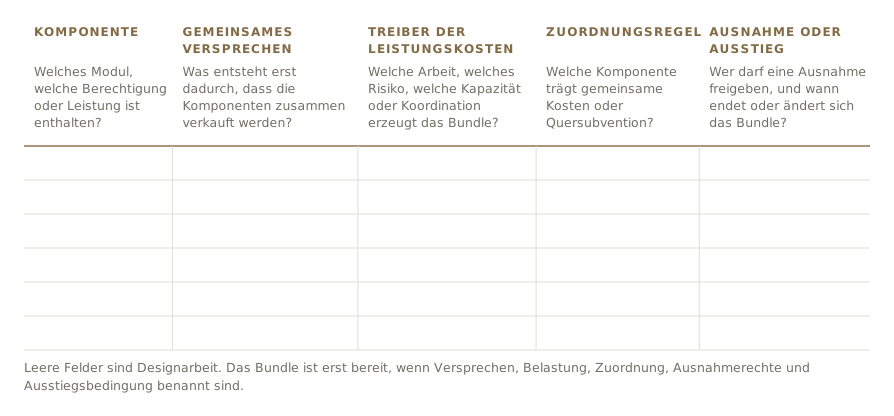
Halten Sie das gemeinsame Kundenversprechen und die gemeinsame Lieferbelastung im selben Entscheidungsobjekt. Ein Bundle ist unvollständig, wenn Zuordnung, Ausnahmerechte oder Ausstieg fehlen.
Referenz & Evidenz
Quelle: Autorenseitiges Bundle-Entscheidungsarbeitsblatt auf Grundlage von Simon (2015), Zbaracki et al. (2004), Kienzler et al. (2021) und Urbany et al. (1989). Alle Felder sind synthetisch; aktuelle Bundle-Daten werden nicht gezeigt.
Jede Zeile ist eine geprüfte Aussage aus dem Prüfregister des Journals, beim Build aus dem Register aufgelöst. Das Register wird auf Englisch geführt.
- B Price is not one number: the book sets out "the many dimensions of prices": bundles, negotiated prices, wholesale, retail and manufacturers' suggested retail prices Simon (2015), pp. 11-13 · published full text ·
G04-C1 - B In B2B the list price is a starting point: suppliers use it "at best as guidance or starting point they negotiate intensely over terms and conditions such as discounts payment terms order minimums and on invoice and off invoice rebates" Simon (2015), pp. 12-13 · published full text ·
G04-C2 - A The cost types, named: "we identify and measure three types of managerial costs information gathering decision making and communication costs and two types of customer costs communication and negotiation costs" zbaracki-etal-2004-price-adjustment-costs · published full text ·
G04-C5 - A One firm, and the paper says so: the totals are "1 22 of the company s revenue and 20 03 of the company s net margin": a single U.S. industrial manufacturer, not a benchmark zbaracki-etal-2004-price-adjustment-costs · published full text ·
G04-C6 - A At equal cost, 68% of purchasing professionals chose the flat rate (Study 1, n = 124, ~40 per condition, cloud analytics). The design is scenario-based: "A series of four experiments showed that experienced purchasing professionals tend to exhibit a flat-rate bias in their price plan choices", and "they preferred the flat-rate over the pay-per-use option" in the equal condition Kienzler, Kowalkowski & Kindström (2021), Journal of Business Research 132, 403–415 · VoR held ·
KKK21-C1 - A Only the bounds varied: "All participants saw the same past average monthly usage (500 h), but the minimum and maximum usage values were varied to create two conditions (100 and 600 h versus 400 and 900 h, respectively)", and "Participants in the equal condition (89%) were significantly more likely than chance to choose the flat rate when past usage indicated upper bound extremes", while "However, this was not the case (56%) when past usage information indicated lower bound extremes" Kienzler, Kowalkowski & Kindström (2021), Journal of Business Research 132, 403–415 · VoR held ·
KKK21-C3 - A The KKT prediction held: "we obtain empirical support for kkt s prediction that unjustified price increases are perceived as unfair while cost justification legitimates a price increase in consumers eyes" urbany-madden-dickson-1989-dual-entitlement ·
URB89-C1
Prüfgrade: A, gegen die gedruckte Seite der Primärquelle geprüft · B, Primärquelle, nur Textebene · C, belastbare Sekundärquelle · D, berichtet.
Verwandte Abbildungen
-
Versprechen und Kostengrenze einer Preisstufe
Aus dem Beitrag Preisstufen sind ein Versprechen mit einer Kostengrenze
-
Die sieben Schichten der Preisarchitektur
Aus dem Beitrag Preisarchitektur ist ein System, keine Preisliste
-
Die Kontrollkarte für dynamische Preise
Aus dem Beitrag Dynamische Preise brauchen Auslöser, Begrenzung und Erklärung