The tier-promise and cost boundary
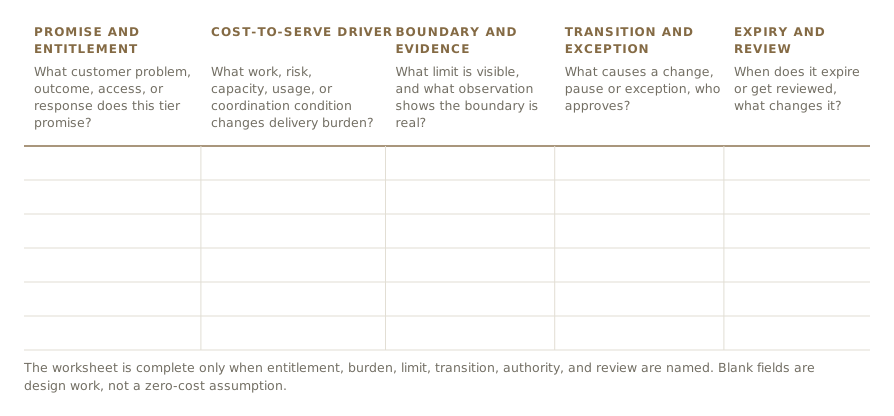
Keep the customer promise and the provider's delivery boundary in the same row. A tier is incomplete when its transition or exception rule is blank.
Reference & Evidence
Source: Author's decision worksheet grounded in Zbaracki et al. (2004), Urbany, Madden and Dickson (1989), Kienzler, Kowalkowski and Kindström (2021), and Grennan and Swanson (2020). Labels are synthetic; no prices, customer terms, or current service data are shown.
Each line is a claim from the register this journal publishes against, resolved from the register at build time.
- A The cost types, named: "we identify and measure three types of managerial costs information gathering decision making and communication costs and two types of customer costs communication and negotiation costs" zbaracki-etal-2004-price-adjustment-costs · published full text ·
G04-C5 - A One firm, and the paper says so: the totals are "1 22 of the company s revenue and 20 03 of the company s net margin": a single U.S. industrial manufacturer, not a benchmark zbaracki-etal-2004-price-adjustment-costs · published full text ·
G04-C6 - A The KKT prediction held: "we obtain empirical support for kkt s prediction that unjustified price increases are perceived as unfair while cost justification legitimates a price increase in consumers eyes" urbany-madden-dickson-1989-dual-entitlement ·
URB89-C1 - A And the part usually dropped: "we also find however that fairness perceptions are not significantly related to behavioral intentions as the theory would suggest" urbany-madden-dickson-1989-dual-entitlement ·
URB89-C2 - A At equal cost, 68% of purchasing professionals chose the flat rate (Study 1, n = 124, ~40 per condition, cloud analytics). The design is scenario-based: "A series of four experiments showed that experienced purchasing professionals tend to exhibit a flat-rate bias in their price plan choices", and "they preferred the flat-rate over the pay-per-use option" in the equal condition Kienzler, Kowalkowski & Kindström (2021), Journal of Business Research 132, 403–415 · VoR held ·
KKK21-C1 - A Only the bounds varied: "All participants saw the same past average monthly usage (500 h), but the minimum and maximum usage values were varied to create two conditions (100 and 600 h versus 400 and 900 h, respectively)", and "Participants in the equal condition (89%) were significantly more likely than chance to choose the flat rate when past usage indicated upper bound extremes", while "However, this was not the case (56%) when past usage information indicated lower bound extremes" Kienzler, Kowalkowski & Kindström (2021), Journal of Business Research 132, 403–415 · VoR held ·
KKK21-C3 - A Hospitals gaining peer-price benchmarking saved 3.3% on physician-preference items and 3.9% where buying in high volume: "under transparency for hospitals purchasing PPIs at formerly high prices (3.3% savings) and in relatively high quantities (3.9% savings)". The object of study is the information, not the price level: "we empirically examine the effect of transparency in the form of benchmarking information on prices negotiated by hospitals and their suppliers" Grennan & Swanson (2020), Journal of Political Economy 128(4), 1234–1268 · VoR held, no page citations ship ·
GS20-C1
Grades: A, verified against the printed page of the primary source · B, primary source, text layer only · C, authoritative secondary · D, reported.
Related exhibits
-
The bundle promise and delivery boundary
From the essay Pricing architecture is a system, not a price list
-
The dynamic-price control map
From the essay Dynamic pricing needs a trigger, constraint, and explanation
-
The synthetic price-adjustment cost ledger
From the essay What is price adjustment cost? Changing a price changes more than a number