Die Kontrollkarte für dynamische Preise
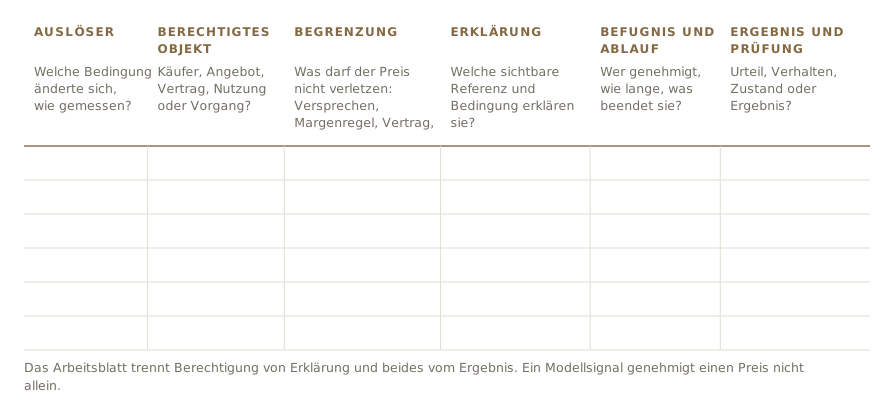
Ein wechselnder Preis braucht Auslöser, geschützte Grenze, sichtbare Referenz, Verantwortliche, Ablauf und Ergebnis. Ein leeres Feld ist eine offene Kontrollfrage.
Referenz & Evidenz
Quelle: Entscheidungsarbeitsblatt des Autors auf Grundlage von Zhang, Netzer und Ansari (2014), Urbany, Madden und Dickson (1989), Kahneman, Knetsch und Thaler (1986) sowie Zbaracki et al. (2004). Die Bezeichnungen sind synthetisch; Kundenkennungen, Preise, Algorithmen und aktuelle Betriebsdaten werden nicht gezeigt.
Jede Zeile ist eine geprüfte Aussage aus dem Prüfregister des Journals, beim Build aus dem Register aufgelöst. Das Register wird auf Englisch geführt.
- A Two latent states, named in the paper: "a “vigilant” state that is characterized by heightened price sensitivity and a cautious approach to ordering and a “relaxed” state with purchase behaviors that are consistent with high relational trust", and "the seller's pricing decisions can transition buyers between these two states". One industrial-consumables retailer, longitudinal transactions zhang-netzer-ansari-2014-dynamic-targeted-pricing ·
ZNA14-C1 - A The KKT prediction held: "we obtain empirical support for kkt s prediction that unjustified price increases are perceived as unfair while cost justification legitimates a price increase in consumers eyes" urbany-madden-dickson-1989-dual-entitlement ·
URB89-C1 - A And the part usually dropped: "we also find however that fairness perceptions are not significantly related to behavioral intentions as the theory would suggest" urbany-madden-dickson-1989-dual-entitlement ·
URB89-C2 - A "it is acceptable for a firm to raise prices or cut wages when profits are threatened and to maintain prices when costs diminish it is unfair to exploit shifts in demand by raising prices or cutting wages" kahneman-knetsch-thaler-1986-fairness ·
KKT86-C1 - A Dual entitlement, defined: "transactors have an entitlement to the terms of the reference transaction and firms are entitled to their reference profit" kahneman-knetsch-thaler-1986-fairness ·
KKT86-C2 - A The cost types, named: "we identify and measure three types of managerial costs information gathering decision making and communication costs and two types of customer costs communication and negotiation costs" zbaracki-etal-2004-price-adjustment-costs · published full text ·
G04-C5 - A One firm, and the paper says so: the totals are "1 22 of the company s revenue and 20 03 of the company s net margin": a single U.S. industrial manufacturer, not a benchmark zbaracki-etal-2004-price-adjustment-costs · published full text ·
G04-C6
Prüfgrade: A, gegen die gedruckte Seite der Primärquelle geprüft · B, Primärquelle, nur Textebene · C, belastbare Sekundärquelle · D, berichtet.
Verwandte Abbildungen
-
Der synthetische Fairnessdatensatz für Preise
Aus dem Beitrag Was ist Preisfairness? Ein Problem von Referenz und Prozess
-
Versprechen und Kostengrenze einer Preisstufe
Aus dem Beitrag Preisstufen sind ein Versprechen mit einer Kostengrenze
-
Versprechen und Leistungsgrenze des Bundles
Aus dem Beitrag Preisarchitektur ist ein System, keine Preisliste