← Every exhibit
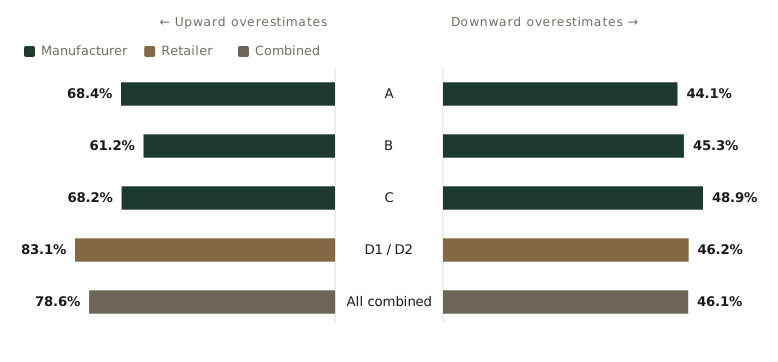
Directional impact of judgmental forecast adjustments
The mirror isolates the asymmetry: upward overrides overshoot reality in every organisation more often than downward cuts do.
Reference & Evidence
Source: Fildes, Goodwin, Lawrence & Nikolopoulos (2009), International Journal of Forecasting 25(1), pp. 3–23, Tables 1, 5a and 5b.
Each line is a claim from the register this journal publishes against, resolved from the register at build time.
- A The dataset is counted in the paper: "we collected data on more than 60 000 forecasts and outcomes from four supply chain companies", 68,984 complete triples in Table 1, and "in three of the companies on average judgmental adjustments increased accuracy" Fildes, Goodwin, Lawrence & Nikolopoulos (2009), abstract and Table 1 ·
FGLN09-C1 - A Upward adjustments were more likely to damage accuracy than downward adjustments Fildes, Goodwin, Lawrence & Nikolopoulos (2009), section 4.1 ·
FGLN09-C3 - A The asymmetry, verbatim: "66% of positive adjustments for companies a c and 83% of those made by d1 and d2 led to forecasts that were too high", against "only 46% of the negative adjustments" Fildes, Goodwin, Lawrence & Nikolopoulos (2009), Tables 5a and 5b ·
FGLN09-C4 - A Downward adjustments tended to correct upward-biased baselines and reflect demand constraints Fildes, Goodwin, Lawrence & Nikolopoulos (2009), section 4.2 ·
FGLN09-C5
Grades: A, verified against the printed page of the primary source · B, primary source, text layer only · C, authoritative secondary · D, reported.