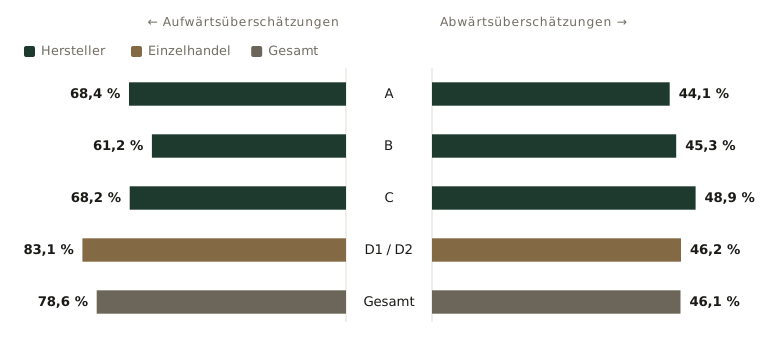
Auswirkungen manueller Prognoseanpassungen nach Richtung
Der Spiegel legt die Asymmetrie frei: Aufwärtskorrekturen überschätzen in jedem Unternehmen häufiger als Abwärtskorrekturen.
Referenz & Evidenz
Quelle: Fildes, Goodwin, Lawrence & Nikolopoulos (2009), International Journal of Forecasting 25(1), S. 3–23, Tabellen 1, 5a und 5b.
Jede Zeile ist eine geprüfte Aussage aus dem Prüfregister des Journals, beim Build aus dem Register aufgelöst. Das Register wird auf Englisch geführt.
- A The dataset is counted in the paper: "we collected data on more than 60 000 forecasts and outcomes from four supply chain companies", 68,984 complete triples in Table 1, and "in three of the companies on average judgmental adjustments increased accuracy" Fildes, Goodwin, Lawrence & Nikolopoulos (2009), abstract and Table 1 ·
FGLN09-C1 - A Upward adjustments were more likely to damage accuracy than downward adjustments Fildes, Goodwin, Lawrence & Nikolopoulos (2009), section 4.1 ·
FGLN09-C3 - A The asymmetry, verbatim: "66% of positive adjustments for companies a c and 83% of those made by d1 and d2 led to forecasts that were too high", against "only 46% of the negative adjustments" Fildes, Goodwin, Lawrence & Nikolopoulos (2009), Tables 5a and 5b ·
FGLN09-C4 - A Downward adjustments tended to correct upward-biased baselines and reflect demand constraints Fildes, Goodwin, Lawrence & Nikolopoulos (2009), section 4.2 ·
FGLN09-C5
Prüfgrade: A, gegen die gedruckte Seite der Primärquelle geprüft · B, Primärquelle, nur Textebene · C, belastbare Sekundärquelle · D, berichtet.
Verwandte Abbildungen
-
Das synthetische Forecast-Override-Prüfregister
Aus dem Beitrag Was ist ein Forecast-Override? Urteil ist ein Eingriff in die Daten
-
Das asymmetrische RevOps-Override-Protokoll
Aus dem Beitrag Die Zahl, die Sie melden
-
Das CRM-Qualitätsregister auf Feldebene
Aus dem Beitrag Was ist CRM-Daten-Governance? Umsatzkontrolle vor dem Reporting