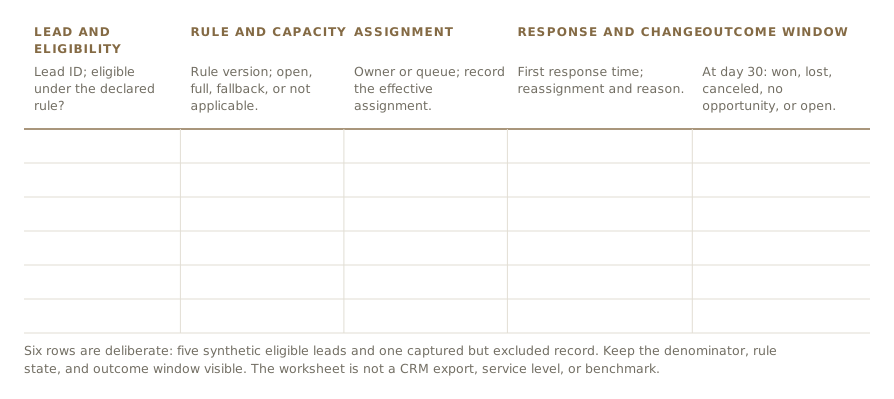
The lead-assignment worksheet
Keep eligibility, rule version, capacity, owner, response, reassignment, and outcome in one reviewable worksheet row.
Reference & Evidence
Source: Author's synthetic assignment worksheet grounded in Virtanen, Parvinen, and Rollins (2015), Friend, Curasi, Boles, and Bellenger (2014), and Friend, Ranjan, and Johnson (2019). The fields are prompts; the example values are illustrative, not benchmarks or service levels.
Each line is a claim from the register this journal publishes against, resolved from the register at build time.
- A Virtanen et al. classify leads as won, lost, or canceled, with canceled separate from a customer decision to purchase elsewhere Virtanen, Parvinen, and Rollins (2015), full-text receipt ·
V07-VPR-C2 - A Their study combines salesperson interviews, CRM analysis, and executive discussion and does not provide a general close-rate benchmark or individual lead explanation Virtanen, Parvinen, and Rollins (2015), full-text receipt ·
V07-VPR-C3 - A A buyer-side account is a distinct evidence layer from seller explanation, and the qualitative study is not a universal reason taxonomy Friend, Curasi, Boles, and Bellenger (2014), full-text receipt ·
V07-FCB-C2 - A Friend, Ranjan, and Johnson describe failing fast as collecting prospect intent, interpreting it, and deciding whether to stop pursuing early Friend, Ranjan, and Johnson (2019), full-text receipt ·
V07-FRJ-C1 - B Lead routing is the rule that assigns an eligible lead to an owner or queue under a declared population and time boundary Author framework ·
V07-OWN-C1 - B Lead capture, qualification, routing, follow-up, reassignment, and outcome are different process objects Author taxonomy ·
V07-OWN-C2 - B The synthetic six-lead ledger produces 100% assignment coverage, 60% response completion, 80% opportunity creation, 20% wins per eligible lead, and 25% wins per created opportunity Author synthetic arithmetic ·
V07-OWN-C4
Grades: A, verified against the printed page of the primary source · B, primary source, text layer only · C, authoritative secondary · D, reported.
Related exhibits
-
What does lead routing mean?
From the essay What is lead routing? Assignment is a measurement boundary
-
What does a routing worksheet look like?
From the essay What is lead routing? Assignment is a measurement boundary
-
How should a team review a routing rule?
From the essay What is lead routing? Assignment is a measurement boundary