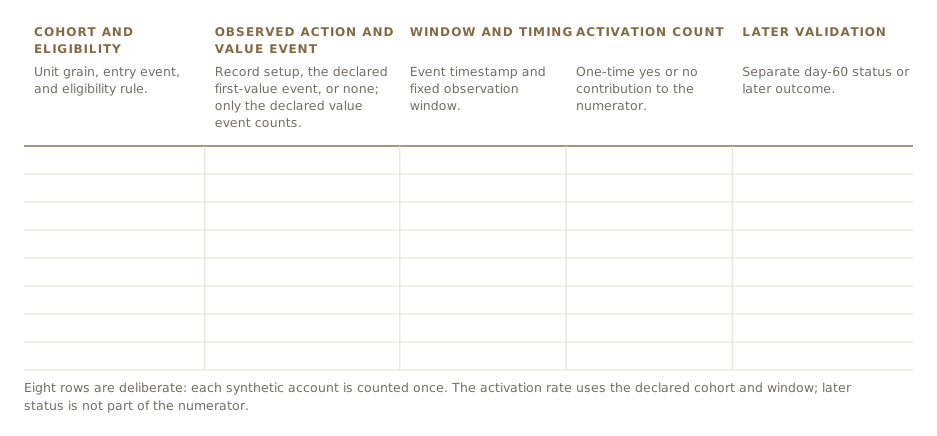
The activation-rate cohort worksheet
Keep the eligible cohort, first-value event, fixed window, activation count, and later outcome visible as separate objects.
Reference & Evidence
Source: Author's synthetic cohort worksheet grounded in Retana et al. (2016), Ascarza et al. (2016), and Steinhoff et al. (2025). The prompts and example values are illustrative, not benchmarks.
Each line is a claim from the register this journal publishes against, resolved from the register at build time.
- B Activation rate is the share of eligible units that reach a declared first-value event inside a fixed window Author framework ·
G03-OWN-C1 - B A reproducible activation record names unit grain, entry event, eligibility, activation event, timing, window, and counting rule Author framework ·
G03-OWN-C3 - B The synthetic worksheet has eight eligible units, four first-value events inside 14 days, and 4 / 8 = 50% Author synthetic arithmetic ·
G03-OWN-C4 - B Setup completion and descriptive retention among activated units are separate from activation rate Author framework ·
G03-OWN-C5 - B Changing event, cohort, unit grain, or window changes the comparison object before it proves product improvement Author boundary ·
G03-OWN-C6
Grades: A, verified against the printed page of the primary source · B, primary source, text layer only · C, authoritative secondary · D, reported.
Related exhibits
-
What does an activation-rate worksheet look like?
From the essay What is activation rate? The first value event must be observable
-
What does activation rate measure?
From the essay What is activation rate? The first value event must be observable
-
How should a team review an activation definition?
From the essay What is activation rate? The first value event must be observable