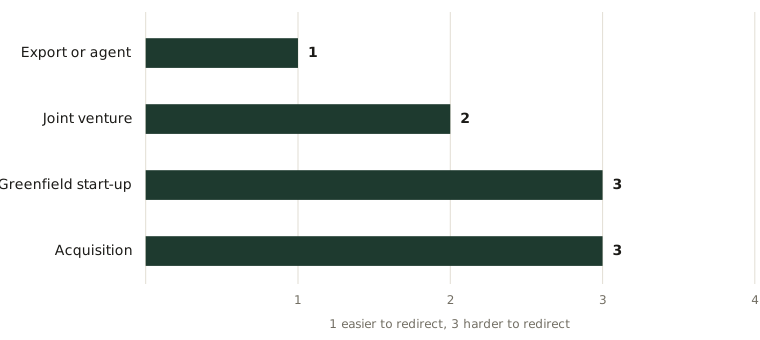
Conceptual commitment and redirectability by route
The chart displays one author-generated commitment dimension. The mode commitment ledger keeps control, learning, relationship dependence, integration work, and validation separate.
Reference & Evidence
Source: Author-generated conceptual ordering grounded in Johanson and Vahlne (1977, 2009), Barkema and Vermeulen (1998), and Barkema, Bell and Pennings (1996). Code 1 means easier to redirect resources and code 3 means harder to redirect them in this conceptual design. The codes are not measured mode scores, a universal ranking, or a performance forecast.
Each line is a claim from the register this journal publishes against, resolved from the register at build time.
- A Commitment has an amount and a degree, and specialisation drives the degree: "The more specialized the resources are to the specific market" "the greater is the degree of commitment" johanson-vahlne-1977-internationalization-process ·
JV77-C4 - A The two kinds of knowledge are distinguished in the paper: "We can also distinguish" "between general knowledge and market-specific" knowledge, the latter gained mainly through market experience johanson-vahlne-1977-internationalization-process ·
JV77-C5 - A The reason for adding knowledge creation is relational: "new knowledge is developed in relationships" johanson-vahlne-2009-liability-of-outsidership ·
JV09-C5 - A The mechanism the authors give for the acquisition side: "The acquired firm needs to unlearn" old routines in technology, rules, procedures, conventions and strategies barkema-vermeulen-1998-start-up-or-acquisition ·
BV98-C5 - A The double layer is the authors' own term: "Cultural distance is a prominent factor in foreign entry whenever this involves another firm, requiring the firm to engage in" double-layered acculturation, "signaling adjustment to both a foreign national and an alien corporate culture" barkema-bell-pennings-1996-foreign-entry-learning ·
BBP96-C2 - A Where the learning shows up, in the authors' words: "the longevity of foreign entries, in which the firm has a majority stake, improves whenever the expanding firm engaged in prior entries in the same country and in other countries in the same cultural block" barkema-bell-pennings-1996-foreign-entry-learning ·
BBP96-C3
Grades: A, verified against the printed page of the primary source · B, primary source, text layer only · C, authoritative secondary · D, reported.
Related exhibits
-
How should corporate development teams maintain a mode commitment ledger?
From the essay Market-entry mode trades control for learning and reversibility
-
The two-part route ledger
From the essay The channel that books the sale may not own the customer
-
The synthetic channel-contribution ledger
From the essay What is channel economics? Revenue share is not channel profit