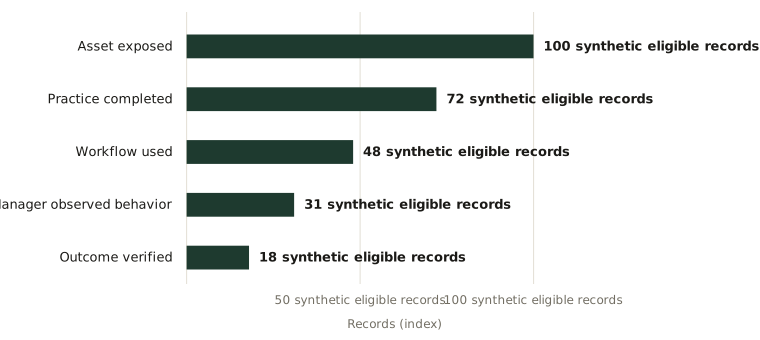
The synthetic sales-enablement metric ladder
A useful enablement metric follows the chain from exposure to completed practice, observed workflow behavior, and a verified outcome.
Reference & Evidence
Source: Author's synthetic metric ladder grounded in Ahearne, Hughes and Schillewaert (2007) and Jelinek, Ahearne, Mathieu and Schillewaert (2006). Counts are illustrative and do not estimate training ROI, conversion, or sales effectiveness.
Each line is a claim from the register this journal publishes against, resolved from the register at build time.
- A Two companies, positive effect: "using data collected from two companies we show that despite uncertain results and the frequent resistance among salespeople to it interventions it acceptance indeed has a positive effect on sales performance" Ahearne, Hughes & Schillewaert. (2007) ·
AHS07-C1 - A The proposed mechanism, in their words: "salespeople using it expand their knowledge and in turn gain improved targeting abilities enhanced presentation skills and increased call productivity" Ahearne, Hughes & Schillewaert. (2007) ·
AHS07-C2 - A Acceptance is the variable, not provision: "it acceptance indeed has a positive effect on sales performance", and the incentive to accept follows from what acceptance buys the salesperson Ahearne, Hughes & Schillewaert. (2007) ·
AHS07-C3 - A The design is in the title: "a longitudinal examination of individual organizational and contextual factors on sales technology adoption and job performance" Jelinek, Ahearne, Mathieu & Schillewaert. (2006) ·
JAMS06-C1 - A Adoption is modelled as shaped by those three families of factors: "individual organizational and contextual factors on sales technology adoption" Jelinek, Ahearne, Mathieu & Schillewaert. (2006) ·
JAMS06-C2 - B Sales-enablement metrics measure a declared behavior, capability, output, or commercial outcome after an enablement intervention Author framework grounded in AHS07-C1 and JAMS06-C1 ·
V12-OWN-C1 - B Activity, adoption, knowledge, behavior change, opportunity outcome, and revenue outcome are different enablement objects Author taxonomy ·
V12-OWN-C2 - B Training completion or content usage does not by itself establish behavior change, seller productivity, or revenue impact Author negative boundary grounded in AHS07-C2 and AHS07-C3 ·
V12-OWN-C4
Grades: A, verified against the printed page of the primary source · B, primary source, text layer only · C, authoritative secondary · D, reported.
Related exhibits
-
The CRM adoption release card
From the essay CRM adoption is knowledge integration, not a rollout
-
The digitization paired-outcome review card
From the essay Digitization changes sales effectiveness and job insecurity
-
The synthetic sales-productivity time allocation
From the essay What is sales productivity? Activity is not productive selling time