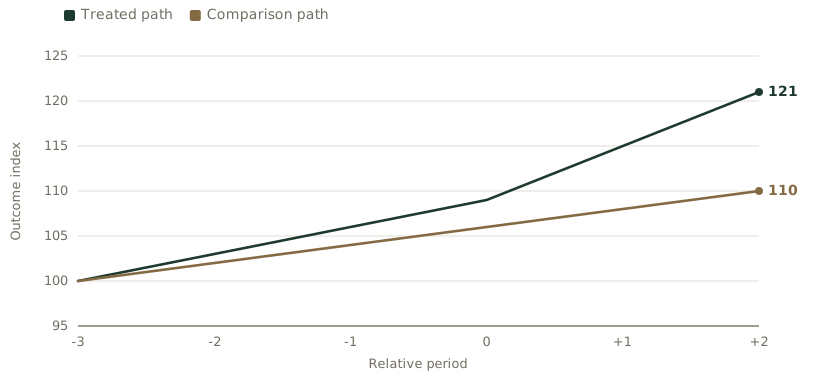
The synthetic parallel-trends screen
A similar pre-period path can motivate a design review, but it does not reveal the treated group's post-period counterfactual.
Reference & Evidence
Source: Author's synthetic trend illustration grounded in Callaway and Sant'Anna (2021) and Roth, Sant'Anna, Bilinski and Poe (2023). The indexed paths illustrate a review question, not an observed treatment effect or benchmark.
Each line is a claim from the register this journal publishes against, resolved from the register at build time.
- A The parameter, named: "the disaggregated causal parameter that we call the group time average treatment effect i e the average treatment effect for group g at time t where a group is defined by the time period when units are first treated" Callaway & Sant'Anna. (2021) ·
CS21-C1 - A Parallel trends is the identifying assumption: comparison groups "would have followed parallel paths over time which is the so called parallel trends assumption" Callaway & Sant'Anna. (2021) ·
CS21-C2 - A A synthesis with advice attached: "this paper synthesizes recent advances in the econometrics of difference in differences did and provides concrete recommendations for practitioners" Roth, Sant'Anna, Bilinski & Poe. (2023) ·
RSP23-C1 - A TWFE is the baseline it complicates: the ATT "can be consistently estimated using a two way fixed effects twfe regression specification" under the canonical assumptions, and recent advances are classified as relaxing those Roth, Sant'Anna, Bilinski & Poe. (2023) ·
RSP23-C2 - B Parallel trends is a design assumption that treated and comparison units would have followed comparable outcome paths absent treatment Author framework grounded in CS21-C1 and RSP23-C1 ·
R10-OWN-C1 - B Pre-treatment visual similarity is evidence about the assumption, not proof that post-treatment counterfactual trends are parallel Author boundary ·
R10-OWN-C2 - B A parallel-trends review should declare treatment timing, comparison set, outcome, pre-period, post-period, aggregation, and event maturity Author operating framework ·
R10-OWN-C3 - B Anticipation, composition change, differential shocks, staggered timing, and outcome redefinition can threaten a parallel-trends argument Author diagnostic framework ·
R10-OWN-C4
Grades: A, verified against the printed page of the primary source · B, primary source, text layer only · C, authoritative secondary · D, reported.
Related exhibits
-
The staggered DiD estimand release gate
From the essay Staggered difference-in-differences needs a cohort-time estimand
-
The synthetic lineage reconstruction table
From the essay What is data lineage? The transformations behind a result
-
The synthetic selection-bias eligibility ledger
From the essay What is selection bias? The sample can change the answer