← Every exhibit
Three records, three decisions
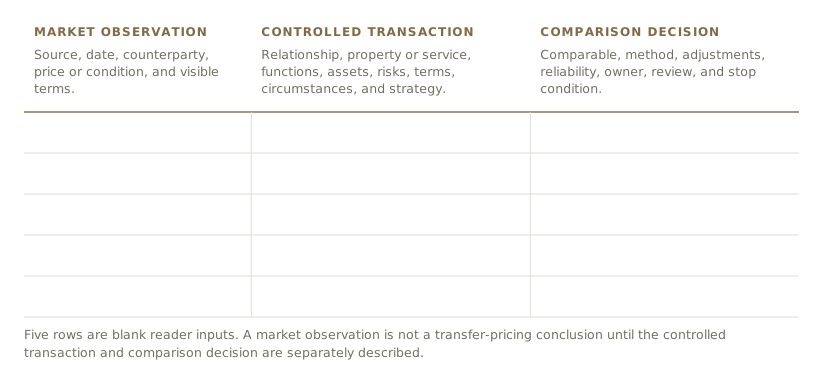
Keep the public observation, the controlled-transaction record, and the comparison decision in separate rows.
Reference & Evidence
Source: Author's worksheet grounded in the documentation and comparability boundaries in OECD (2022) and United Nations (2021). Blank fields are reader inputs; no legal or company conclusion is supplied.
Each line is a claim from the register this journal publishes against, resolved from the register at build time.
- A The comparability process moves from transaction understanding and functions to methods, comparables, adjustments, and arm's-length remuneration; reliability matters more than a compulsory process OECD (2022), pp. 150-151 · official full text ·
OECD22-C4 - A The documentation framework separates group-level master-file information, transaction-level local-file information, and aggregate Country-by-Country reporting OECD (2022), pp. 231-233 · official full text ·
OECD22-C5 - A The practical process includes transaction understanding, comparability factors, methods, comparables, adjustments, documentation, and monitoring, and is not necessarily linear United Nations (2021), pp. 52-53 · official full text ·
UNTP21-C3
Grades: A, verified against the printed page of the primary source · B, primary source, text layer only · C, authoritative secondary · D, reported.