Die Prüfpunktfolge für Marktpriorisierung
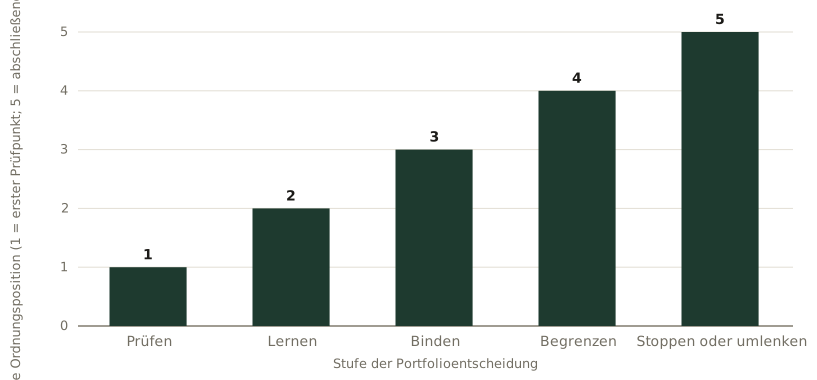
Die nächste Bindung ist eine Prüfpunktfolge und kein dauerhafter Gewinner: prüfen, lernen, binden, begrenzen und bei einer verletzten Bedingung stoppen oder umlenken.
Referenz & Evidenz
Quelle: Autorensynthese auf Grundlage von Goodman (1972), Natarajarathinam und Nepal (2012), Waheeduzzaman (2008), Bruna (2024) und Klinger (1977). Die Balkenhöhen sind vom Autor definierte Ordnungspositionen, von 1 für den ersten Prüfpunkt bis 5 für die abschließende Entscheidung; sie sind keine Marktwerte, Leistungsmaße, Wahrscheinlichkeiten oder Rankings.
Jede Zeile ist eine geprüfte Aussage aus dem Prüfregister des Journals, beim Build aus dem Register aufgelöst. Das Register wird auf Englisch geführt.
- B Goodman's own distinction: market potential is a measure "of an environmental state at a point in time (present or future)", whereas "sales forecasts are measures of expectation which are conditional upon inputs of the various marketing decision variables", and "it is usually necessary to rely on proxy data for most of the things a marketer would like to measure" Goodman. (1972) ·
MSB27-C1 - B The three stages are the paper's own: "The first step assesses the broad market potential of a country; the second step estimates the sales potential for a specific company, and the third step calculates return on investment for the company based on the resources required" Natarajarathinam & Nepal. (2012) ·
MSB27-C2 - B And each stage carries different conditions: "Each step of the methodology accounts for several external and internal factors", demonstrated on "An example of a fastener manufacturer targeting the Mexican market is used to demonstrate the applic"ation, so it is one worked case and not a formula Natarajarathinam & Nepal. (2012) ·
MSB27-C3 - B The four criteria are the paper's own: Table 1 "provides an evaluation of the methods on the basis of four criteria, viz., precision, prediction, price, and pragmatism" Waheeduzzaman. (2008) ·
MSB27-C4 - B The methodological verdict is the paper's own: "The paper concludes that using a single rule to proxy Internal Market Potential in the same way for any sample is a bad methodology", on "For a sample of European regions, the paper concludes that the literature should be more explicit about historical processes of agglomeration" Bruna. (2024) ·
MSB27-C5 - B TAM, SAM, and SOM are useful labels only when their market boundary, unit, date, serviceability, and scenario assumptions are explicit Author framework in the market-allocation ledger ·
MSB27-C6 - B A budget decision requires a visible resource requirement, investment horizon, outcome, and downside case after market and firm reach are stated Author framework grounded in the cited market-potential sources ·
MSB27-C7
Prüfgrade: A, gegen die gedruckte Seite der Primärquelle geprüft · B, Primärquelle, nur Textebene · C, belastbare Sekundärquelle · D, berichtet.